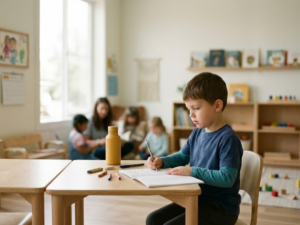
Prepare for the transition from home to school
Start talking about school before the first day. Think about how you feel when you’re returning to work after a long vacation. Even as adults, getting back into the routine can take a little time waking up early, preparing for the day, getting organised and mentally switching back into “work mode.” For children, returning to school can feel much the same.
Revisit familiar routines, talk about what the school day might look like and give your child plenty of opportunities to ask questions. For younger children, practising simple routines such as getting dressed, packing their school bag or saying goodbye can make the morning feel more predictable and less overwhelming.
Make space for big emotions
A child who says, “I don’t want to go to school,” may not simply be refusing school.
They could be communicating:
“I’m nervous.”
“I’m worried I won’t know what to do.”
“Everything feels different.”
Instead of immediately trying to fix the emotion, try acknowledging it:
“It sounds like you’re feeling worried about starting school. It’s okay to feel that way. Let’s work through it together.” It is completely valid for children to feel this way. Starting a new school or even a new grade, can feel much like starting at a new workplace for an adult a new environment, new people, unfamiliar expectations and the pressure to find your place.
Teach emotional regulation before the difficult moments
Children don’t automatically know how to manage frustration, disappointment or anxiety. These are skills that develop through practice.
Help your child identify what their body feels like when they are becoming overwhelmed and practise strategies when they are calm such as deep breathing, movement, taking a short break, sensory activities or asking for help.
The goal isn’t to prevent children from having big emotions. The goal is to help them learn what to do with those emotions.
Remember that moving up a grade is a big step
A new grade can bring new teachers, new expectations, more challenging work and greater independence.
Try not to focus only on academic readiness.
Ask questions such as:
- “What are you looking forward to?”
- “Is there anything you’re worried about?”
- “What would help you feel more confident?”
- “What can you do if you get stuck?”
These conversations help children see that asking for help is a strength, not a failure.
Focus on connection before correction
The back-to-school period can be exhausting for the whole family. If your child becomes more emotional, clingy, irritable or tired than usual, remember that behaviour can also be a form of communication.
Sometimes children need connection, reassurance and regulation before they are ready to listen, learn or problem-solve.
A calm adult can become an important anchor when everything around a child feels new.
As your child heads into a new school year, what is one thing you can do to help them feel more confident, regulated and ready to grow?
Need More Support? We’re Here to Help
Every child experiences the back-to-school transition differently. For some children, the challenges may go beyond emotions and routines. Choosing a comfortable school uniform, managing hair care, carrying and organising a school bag, using stationery, managing lunch boxes and school dinners, or adjusting to before- and after-school routines can all be overwhelming for children with sensory processing differences.
Even things such as travelling to and from school, coping with busy school events or adjusting to new environments and expectations can present additional challenges.
If your child is experiencing difficulties with any of these areas, you don’t have to navigate them alone. At Sensation Station, our therapists can work with you to understand your child’s individual sensory needs and explore practical strategies that can make everyday school routines more comfortable and manageable.
We can support families with areas such as:
- Choosing a school uniform and managing clothing sensitivities
- Hair care and grooming challenges
- Choosing and managing school bags
- Stationery and other school supplies or aids
- Labelling and organising belongings
- School dinners and lunch boxes
- Before- and after-school routines
- Travel and commuting to school
- Managing school events and unfamiliar environments
- Advocating for your child’s sensory processing needs at school
If your child is experiencing challenges in any of these areas, get in touch with our therapists. We can help you understand their needs and identify strategies that support a smoother and more confident transition into the school year.
We will also be sharing separate, detailed blogs on these topics, with practical tips and guidance to help families prepare for the different aspects of going back to school.
Because sometimes, supporting a child isn’t about changing the child it’s about changing the environment, expectations and strategies around them.